What to Save From Your Baby's First Months: Keep a Few Honest Things
Save a few honest things from your baby's first months: notes, photos, and tiny keepsakes that still mean something later.
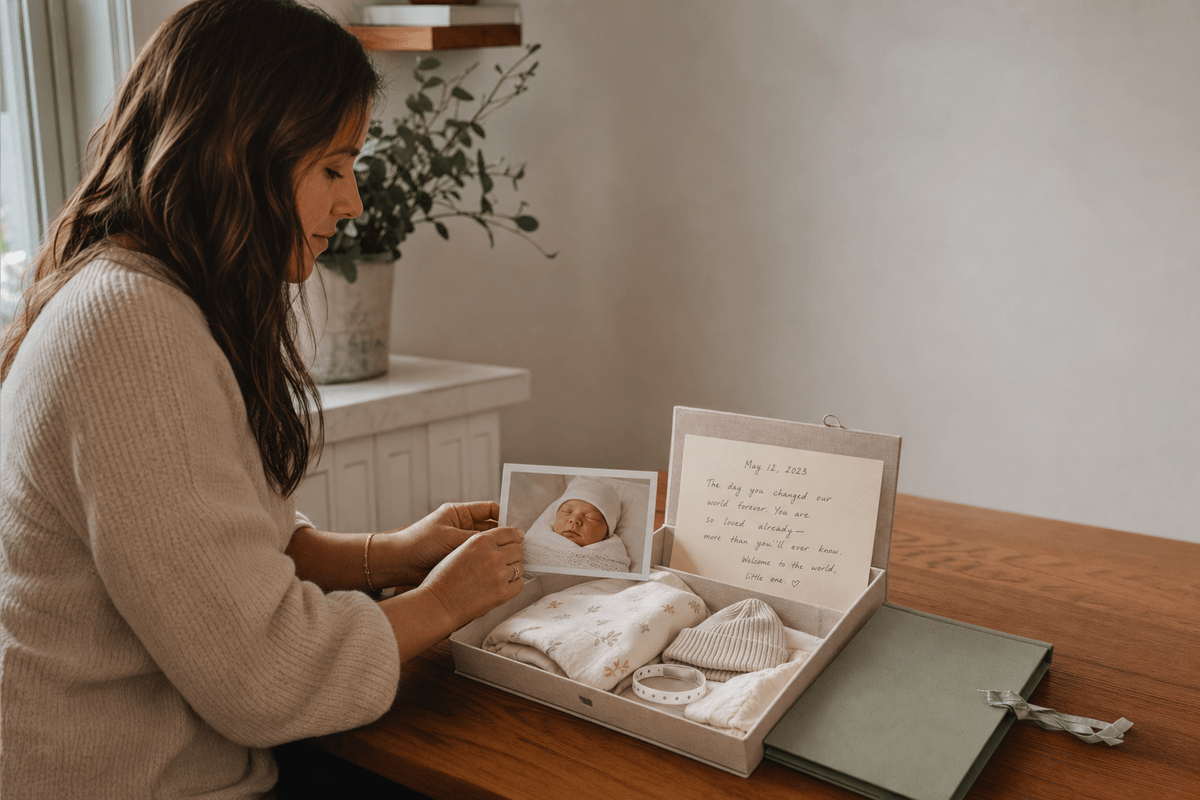
The first months with a baby have a way of disappearing while you are still inside them. You learn the sound that means hunger, the stretch that comes before waking, and the exact walk that settles them. Then the routine changes, and those once-obvious details become surprisingly hard to call back.
That is why deciding what to save from your baby's first months is less about keeping every milestone and more about keeping the ordinary things only your family would recognize. A voice. A gesture. The view from the chair where you spent half the night. A phrase you repeated so often it became part of the room.
Start now with one small action: open a note, write today's date, and finish this sentence: “Right now, you always…” Add one true detail. You have already begun.
This is different from writing a long letter about your hopes for your child. Letters to My Baby is the writing-first guide for that. Here, the aim is a small record of daily family life that your child can receive later or that you can open together and remember as a family.
Babies change quickly across the early months, including how they move, make sounds, notice people, and respond socially, as the American Academy of Pediatrics explains in its early developmental milestones guide. The details worth saving are often not formal milestones at all. They are what happened around them.
Why everyday details matter more than a perfect record
Milestone lists tell you when something happened. Everyday details tell your child what it felt like to be there.
A future reader may like knowing the month of their first smile. They may feel something deeper when they learn that they smiled every time the kitchen tap ran, tucked both hands under their chin before sleep, or went quiet when a particular grandparent began to sing.
The strongest keepsakes from this stage usually answer one of four questions:
- What did you sound like?
- How did you move?
- What did an ordinary day in our home feel like?
- How did we respond to you?
You do not need a complete baby archive. You need enough specific detail for the memory to feel inhabited later.
What to save from your baby's first months
Choose a small mix of words, images, and physical objects. Each piece should add something the others cannot.
One line that catches their voice
In the first months, “voice” may mean a squeak, coo, cry, sigh, or the small sound your baby makes when they are about to fall asleep. You do not have to translate it into a milestone. Describe it as you hear it.
Try writing:
- “You make a soft humming sound when you drink.”
- “Your first laugh arrived as three surprised little bursts.”
- “You answer the morning light with a long, serious conversation of coos.”
If you record a voice memo for your own archive, add a dated sentence explaining what is happening. The sentence is what will make the sound understandable later. If you use a text-and-image capsule, write down the sound in your own words rather than assuming the recording can be added.
One gesture that already feels like them
Gestures can disappear before anyone thinks to name them. Notice what your baby does with their hands, eyebrows, feet, or whole body.
Maybe they press one foot against you during a feed. Perhaps they turn their head toward the same window every morning. They might lift both arms when a familiar person enters, grip your shirt while settling, or wrinkle their nose just before a smile.
Write the gesture down, then add a photo if you have one. A photo shows the movement; your sentence explains why the family noticed it.
One ordinary scene from home
The scene does not need to be beautiful. In fact, the unpolished view may be the one that carries the most truth later.
Save a photo of:
- the corner where early feeds happened
- the blanket always on the sofa
- bottles drying beside the sink
- the pram by the door after a familiar walk
- a sleepy morning with everyone still in yesterday's clothes
Add one line about what cannot be seen. Was the washing machine running again? Was an older sibling telling the baby a complicated story? Was it the first calm hour after a difficult night?
The National Archives offers practical guidance on storing and handling photographs and papers in its guide to preserving family archives. Add context too: a date, names, and one sentence about why the image mattered.
A phrase your family kept saying
Every family develops a temporary language around a new baby. There may be a nickname, a made-up song, a joke about the 4 a.m. shift, or a phrase an older child repeats whenever the baby cries.
Write down the exact words. Do not improve them. The slightly silly, completely ordinary phrase is valuable because it belongs to this one household at this one moment.
You can invite another parent, grandparent, or sibling to contribute their version too. Two sentences from different people often reveal more than one polished account.
One object with a story
Physical keepsakes work best when the story is more important than the object. A hospital bracelet, first hat, tiny sock, or handwritten card can hold a moment, but only if the future reader knows what it meant.
Choose one or two objects rather than a whole drawer. Label each with the date and a short explanation. If the object is fragile, bulky, or unsafe to store, photograph it instead.
For a practical way to edit the physical collection, What to Put in a Baby Keepsake Box explains what to keep, what to skip, and how to avoid turning the box into clutter.
Capture your own voice too
Your child is not the only person changing in these months. You are learning new routines, new worries, and new kinds of tenderness. A few lines in your natural voice can show them who was caring for them before they could remember it.
Keep it plain:
You fell asleep on me after lunch today. I should have moved, but I stayed for another ten minutes because your hand was open on my chest and the whole room was finally quiet.
A small moment like this can tell your child what being loved felt like before they could remember it.
Try to avoid turning every note into advice for the future. Your child may eventually value the details more than the lesson. Tell them what the weather was like, which song everyone was tired of hearing, what made you laugh, or what part of the day you looked forward to.
Build a five-minute memory habit
Memory keeping becomes difficult when it feels like another large project. A small repeatable rhythm works better.
Once a week, save just three things:
- one sentence about a sound or phrase
- one sentence about a gesture or routine
- one photo that shows the setting
Put the date on all three. Stop there.
At the end of the month, choose the strongest set and let the rest remain in your camera roll or notes. Editing is part of remembering. It leaves you with a small group of moments you will actually want to revisit.
If the first birthday becomes the natural closing point, What to Put in a First Birthday Time Capsule can help you turn those monthly details into one focused collection. If you would rather end with a written message, Letters to Your One-Year-Old offers a milestone-specific structure.
Decide how your child will meet these memories
Saving is only half the choice. The other half is deciding how the memories will return.
Your child might receive the capsule directly when they are old enough to understand the notes. Or you might plan to open it together on a birthday, during a move, before the start of school, or at the end of a family season. Choose a day to sit together, look at the photos, and tell the stories behind them.
A near-term date can be surprisingly meaningful. You do not have to wait until adulthood. A collection from the newborn months can be lovely to revisit when your child turns one, when parental leave ends, or before their second birthday. The memory will already feel different, while the details are still close enough to spark a real family conversation.
Choose the date now and add a line explaining why you chose it. That decision gives the collection a destination.
Match the memory to the right home
Some memories belong in a physical box. Others make more sense as text and images that can be delivered later.
Use a physical box for small objects such as a hat, card, or bracelet. Use a digital collection for dated notes, captions, and photographs. If you keep audio or video elsewhere, label it clearly and keep a written description alongside it so the memory is not dependent on one unlabeled file.
Preserly's free Echo capsule is a simple fit for a small, near-term collection made of text and images. It supports up to two recipients and a delivery date within the next two years. It does not need to hold every memory. It can carry the few pieces you want your child—or your family—to meet again on a chosen day.
Start a free Echo capsule, choose a date within the next two years, and add today's sentence plus one honest photo.
What not to save
The first months produce more material than any family needs to keep. Skip:
- duplicate photos that tell the same story
- objects you cannot identify without guessing
- damaged or damp items that may harm the rest of the collection
- generic milestone cards with no personal context
- anything you are keeping only because guilt says you should
If you cannot explain in one sentence why an item matters, you probably do not need it. The goal is not proof that you documented enough. It is a clear gift of recognition for later.
FAQ
What should I save from my baby's first months?
Save one dated note, one description of their voice, one characteristic gesture, one honest photo of daily life, and one or two small objects with a story. A small, specific collection will be easier to understand later than a crowded archive.
How is this different from writing letters to my baby?
A letter usually centers on what you want to tell your child. This kind of collection centers on observation: how they sounded, moved, and fitted into everyday family life. The two formats can sit together, but they serve different purposes.
Can we open the capsule together?
Yes. Choose a date when the family can revisit it in the same place and make that your occasion. You might read the notes aloud and tell your child the stories behind the photos.
Does an Echo capsule hold voice recordings or video?
No. Echo is for text and images. You can describe a sound in writing, include a photo, or transcribe a memorable phrase. Keep original audio or video in an appropriate separate archive, or review Preserly's current options if those formats are essential to your capsule.
What if I did not start during the newborn weeks?
Start with what you remember now. Ask another family member for one detail, look at a photo from the week, and write a short caption. A true fragment is better than a perfect record that never gets made.
Keep one ordinary thing today
Your child's first months do not need a complete documentary. They need a few details that could only belong to them: the sound they made, the movement everyone recognized, the phrase the family repeated, and the room where the days unfolded.
Write one sentence today. Add one photo. Decide whether your child will receive it or whether you will open it together. If a near-term text-and-image capsule fits, start a free Echo capsule and choose a delivery date within the next two years.