Letters to My Baby: What to Write in the First Year
Write letters to your baby with simple prompts for the first year, plus examples, structure, and a calm way to keep them safe for later.
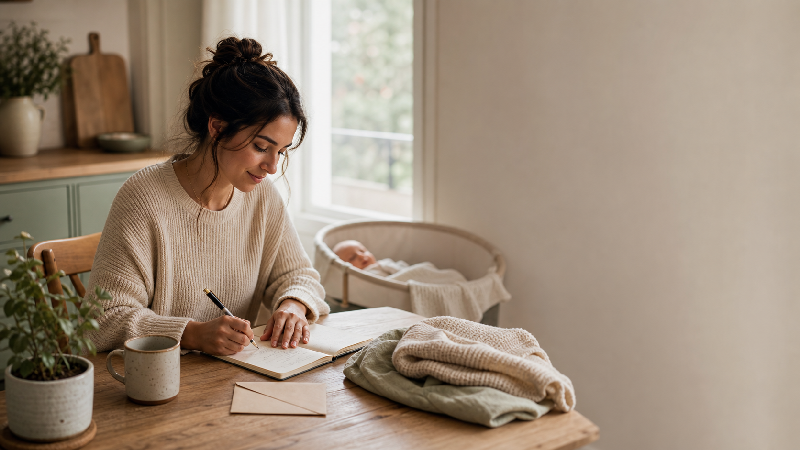
The first year with a baby is full of details that feel too small to save until you realize they were never small at all. The way they settle into your shoulder. The sound they make when they are hungry. By the time you think to write those things down, the day has usually already moved on.
That is why letters to my baby matter. They do not need to be long, polished, or poetic. They only need to catch the life that is happening right now, before it turns into the kind of memory you can only reconstruct in fragments.
If that feels a little like a time capsule, that is because it is. A letter is a future-facing object. It is not just a note for today. It is a message meant to be opened later, when your child can read your voice back to themselves and see what this season felt like from your side of the story.
This piece is the broader companion to Letters to Your One-Year-Old: that post focuses on the first-birthday letter itself, while this one covers the whole first year and the smaller notes you can write along the way. If you want the wider context for the format, Time Capsules for Your Child is the natural place to start.
Why write letters in the first year?
The first year is not memorable because it is neat. It is memorable because it moves quickly and leaves a trail of very human details behind it. The house sounds different at 2 a.m. than it does at 2 p.m. Your body feels different. Your patience feels different. Even the silence changes.
A letter gives those details a place to live. It can hold the night that felt endless, the morning that suddenly felt easier, the first smile, or the way your baby looks at you when they are tired.
The American Academy of Pediatrics tracks how much changes in the 12-month range, from movement to communication to social interaction AAP milestones. That pace is exactly why a written record helps. A few sentences can preserve what memory will blur.
This is also where Preserly’s philosophy makes sense. Why Preserly Starts With Memory, Not Storage explains the same idea from the product side: the point is not to hoard files, but to keep meaningful moments intact until the right future day.
What to write at different stages
You do not need one perfect annual letter. Smaller, honest snapshots across the year usually work better.
In the newborn weeks
The newborn stage is full of firsts that will be easy to forget later because they repeat so often.
Write about:
- what your days and nights actually feel like
- the sound your baby makes when they settle
- the thing that surprised you most about becoming a parent
- the routine that keeps the day from unraveling
A letter from this stage should sound unfiltered and immediate. It does not need a big conclusion. It only needs to say, "This is what life looks like right now."
Around three to six months
By this point, the baby is less mysterious and more specific. You start to know their rhythms, preferences, and habits.
Write about:
- the face they make when they recognize you
- the song that calms them fastest
- the first time they laughed for real
- the moment you realized you were no longer guessing as much
These letters usually feel softer than newborn notes because you have started to see personality, not just needs.
Near the first birthday
The first birthday is where the whole year comes into focus. You can see how much changed and how quickly it happened.
Write about:
- the words or sounds they use now
- the foods they love
- the milestones that felt huge at the time
- the one detail you know you would miss if you did not write it down
If you want a sibling article that focuses specifically on this milestone, Letters to Your One-Year-Old is the companion piece.
A simple formula for any letter
If a blank page makes you freeze, use a repeatable structure. It keeps the letter easy to start and easy to return to.
1. Name the moment
Begin with the age, date, or event. It can be as simple as "You are six months old today" or "I am writing this after your first birthday."
2. Notice one or two details
Add the small facts that will matter later: the expression they make, the sound they love, the way they reach for you, or the routine that keeps the day steady.
3. Leave one hope or promise
End with a feeling or intention. You might say what you hope for them, what you want them to remember, or how loved they are in this moment.
That is enough. The letter needs to preserve, not perform.
Prompts when you do not know what to say
Sometimes the hardest part is not writing. It is starting.
Try one of these prompts:
- "Today I want to remember..."
- "The thing I never want to forget about you right now is..."
- "When I think about your first year, I keep coming back to..."
- "You are changing so fast, and today I noticed..."
- "The moment that made me laugh this week was..."
- "What I want you to know about this season is..."
- "I hope that when you read this later, you understand..."
If you want a more structured set of ideas, Why Preserly Starts With Memory, Not Storage shows why small notes often matter more than polished writing.
You can also turn the prompts into a recurring habit:
- Write one paragraph after a milestone.
- Add one sentence about how you felt that day.
- Save the letter with the date.
That rhythm makes the task manageable.
What a good baby keepsake letter usually includes
A useful letter is usually specific, brief, and warm. It needs enough detail that a future reader can tell it belonged to one real time in your life.
Here is a simple checklist:
- one concrete memory
- one personality detail
- one emotion from you
- one hope for later
For example:
You are seven months old today, and your favorite thing is still the sound of your own voice. You grin when I walk into the room, and every ordinary day feels a little less ordinary because of that. I hope that when you read this someday, you know that you were loved before you could understand what that meant.
That kind of note is enough. It feels human because it is human.
To make yours unmistakably personal, capture three simple things: your voice on the page, one ordinary memory from this week, and a few words written directly to your child. You can do that in a notebook, a document, or a note on your phone. The value is in the details, not in what you buy.
Then choose the future moment. Your child might receive the message themselves, or you might save it for a day when you can open it together as a family. Pick a date that fits your story; it does not need to be a distant milestone for the letter to matter.
How to keep the letters together
A letter feels more meaningful when it has a clear place to live.
You can keep it with a photo, a voice note, a milestone card, or a short list of firsts from the same week. Those pieces help the future reader understand the stage you were in.
If you want the practical setup, How it works shows how a capsule is organized from start to finish. If you are deciding whether the child-focused version is the right fit, Time Capsules for Your Child explains the use case in plain language. And if you want to understand the trust side before you start, Our Promise covers that clearly.
For parents who want the simple operational answer, Pricing is the quick check. The point is to keep a few honest letters safe until your child is ready for them.
When should the letters be opened?
There is no single right date. Some families choose 18th birthday because it feels like a natural threshold into adulthood. Others prefer graduation, 21st birthday, a wedding, or another family milestone.
The best rule is to pick a date that means something to you and write it down now. The date turns the letter from a nice thought into a promise.
If you write several letters across the first year, you can open them all together or spread them across milestones. What matters is that the future moment exists.
If one big letter feels too hard
Write a small one.
A few plain sentences after a long day are better than waiting for the perfect moment that never arrives. The first year needs attention.
That is also why a letter can be one of the simplest forms of memory keeping. You only need to preserve one true moment, then another.
FAQ
What should I write in a letter to my baby?
Write about the stage you are in, what your baby is like right now, and one thing you hope they understand later about being loved.
How long should a letter to my baby be?
Short is fine. A single page with real detail will usually mean more than a long letter that could belong to anyone.
Can I write more than one letter?
Yes. Many parents write at birth, at three months, at six months, and again around the first birthday. Smaller notes often feel easier to keep.
Should the letter be handwritten or digital?
Either works. Handwritten can feel especially intimate, but digital letters are easier to store, duplicate, and open later inside a capsule.
Do I need to be sentimental?
No. Plain, observant language is often stronger than trying to sound poetic. Real details are what make the letter matter.
The real goal
The goal is to make sure a few true sentences survive the speed of the first year.
One day, your child may want to know what life felt like before they could remember it. A letter gives them that answer in your own words.
If you want a simple way to keep that habit going, start with one note today and keep it somewhere that will still make sense later.
Ready to try the idea? Start a free Echo capsule, choose a delivery date within the next two years, and begin with one honest letter.