What to Put in a Baby Keepsake Box: Start Small
A baby keepsake box works best with one dated note and a few chosen memories. See what to save, what to skip, and how to keep it meaningful.
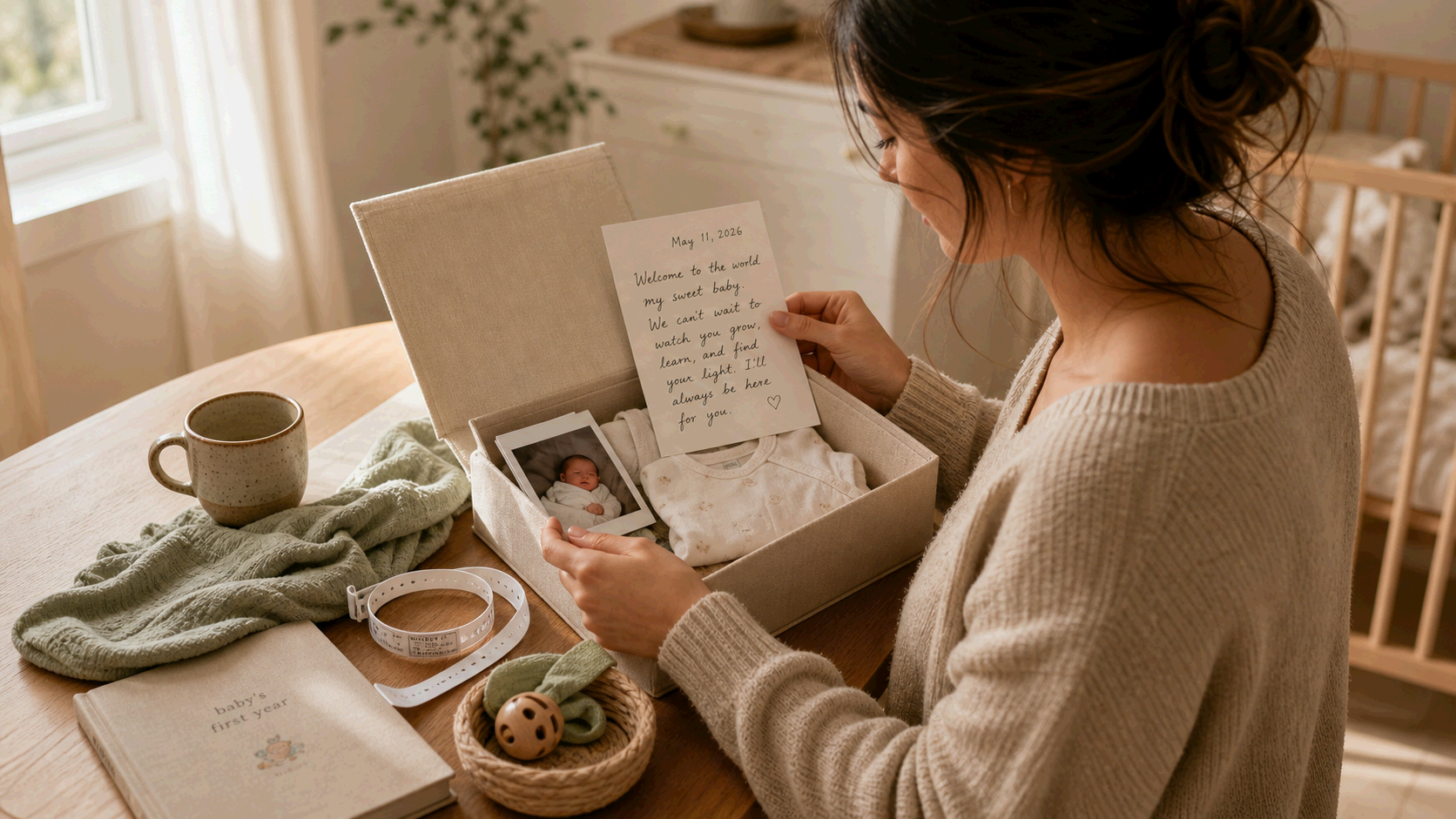
The first year with a baby creates more evidence than you expect. A hospital bracelet. A coming-home outfit. A card from a grandparent. A photo you took in a rush and almost deleted later because it was blurry. Most of those things feel ordinary while you are living them, which is exactly why they matter later.
A baby keepsake box gives those items a place to live, but it does not need to hold everything. In fact, the best box is usually the smallest one that still tells the story clearly. If you are wondering what to put in a baby keepsake box, start with one dated note and a few objects that help you remember the shape of the first year.
The American Academy of Pediatrics notes how quickly babies change across the 12-month mark, especially in movement, communication, and social connection AAP milestones. That pace is part of why a keepsake box matters. You are not saving things because they are precious in the moment. You are saving them because the moment will move on before you are ready.
Think of the box as the physical half of a family time capsule. The Smithsonian's guidance on time capsules is a useful model here: choose items that will still make sense later, preserve them with care, and give them enough context to mean something when the box is opened Smithsonian time capsules. For letters, voice notes, and photo sets that do not fit inside a box, a digital capsule can hold the rest of the story.
The simplest rule for choosing what belongs
When parents start collecting keepsakes, the risk is usually not too little. It is too much. A keepsake box gets heavy fast if it becomes a place for every tiny sock, wrapper, duplicate print, and "maybe I should keep this" object.
The simplest rule is this:
- save one dated note in your own voice
- save one object from the beginning of the year
- save one object from the middle of the year
- save one object from the first birthday
That is enough to make the box feel intentional instead of random. If you want to add one extra item, make it something that carries a voice or a story, like a note from the other parent, a card from grandparents, or a printed photo with a real memory behind it.
What the dated note should say
If you only save one thing, make it the note.
The note gives the rest of the box context. It tells future-you what life felt like, what was surprising, and what you were trying not to forget. Date it the same day you choose the keepsakes. Keep it plain. A few sentences are enough.
Try this structure:
- the date
- one detail you never want to lose
- one feeling from that day
- one hope for later
Example:
May 11, 2026 You smelled like milk and warm laundry today, and you fell asleep with your hand around my finger. I want to remember how ordinary this felt and how precious it was. If you read this later, I hope you know the small parts of your first year were a gift to me.
That kind of note does more work than a crowded box of extras. It turns a few objects into a memory you can read again.
The three keepsakes that usually matter most
Once the note is in place, choose three objects that map the year. Not every family will choose the same ones, and that is fine. The goal is not a perfect archive. The goal is a clear, honest one.
The arrival item
Choose one object from the day your baby arrived or came home. A hospital bracelet, ID band, coming-home outfit, first hat, or small swaddle all work well. Pick the one that still feels like the beginning of everything.
The middle-year item
Pick one thing that says, "this is what life looked like once the early shock had settled." It might be a monthly milestone card, a first laugh photo, a handprint, a short note from the other parent, or a card from a grandparent. The important part is not the category. It is the stage.
The first-birthday item
Save one object from the day the first year closes. A birthday card, a candle, a cake topper, or a printed photo from the party can all work. This item gives the box an ending, which makes it feel like a story instead of a pile.
If you want a shorter version of the rule, save one arrival item, one middle-year item, one first-birthday item, and one dated note. That is the cleanest answer to what to put in a baby keepsake box.
What to skip when you are deciding what goes in
Not everything sentimental belongs in the box. The best keepsake boxes are edited, not stuffed.
Skip:
- anything damp, mold-prone, or already damaged
- duplicate versions of the same milestone
- bulky items that do not tell a story
- fragile objects that will not survive storage
- anything you are keeping only because you feel you should
If something matters but cannot be safely stored, photograph it and save the image somewhere secure. The point of the box is to protect memory, not to create a new storage problem.
How to keep the box meaningful later
A keepsake box is easiest to love later when it is easy to understand later.
Try this simple system:
- Label the box with your child's name and birth date.
- Put paper items in sleeves or envelopes if you have them.
- Add one short note to each item if you can: what it is, where it came from, and why it matters.
- Group items by stage, such as arrival, mid-year, and first birthday.
- Take one photo of the contents so you have a visual inventory.
- Store the box in a cool, dry place where it will not get crushed or damp.
You do not need the box to feel museum-perfect. You only need it to feel honest when you open it years later.
When a digital capsule is the better home
Some of the most meaningful baby memories are not really box-shaped. Letters, voice notes, longer reflections, and photo sets often belong digitally, where they are easier to keep together.
That is where Preserly fits naturally. A physical keepsake box can hold the bracelet and the outfit. A digital capsule can hold the letter you wrote at 2 a.m., the voice note from a tired but happy parent, or the photo sequence you do not want to print yet.
If you want the broader child-focused overview, Time Capsules for Your Child is the simplest starting point. If you want the mechanics, How it works explains the flow. If you are deciding whether the service fits your family, Pricing and Our Promise are the practical pages to read next. And if you want the philosophy behind keeping a few honest moments instead of a pile of files, Why Preserly Starts With Memory, Not Storage is the companion piece.
FAQ
When should I start a baby keepsake box?
Start at birth if you can. If not, start whenever you realize you want a few items from the first year to survive in one place. It is never too late to begin with one object.
How many items should be in a baby keepsake box?
There is no perfect number, but a small edited set usually works better than a large one. Think story, not stash.
Should I put clothes in the box?
Yes, but only one or two pieces that really matter. The coming-home outfit or first hat is usually more meaningful than a random pile of clothes.
Can I include photos?
Yes. Printed photos are often the best bridge between physical keepsakes and the emotional story behind them.
What if I do not have many items?
That is fine. One letter, one photo, and one small object can be enough. The value is in the memory they hold, not the number of things you collect.
The real point
A baby keepsake box is not about preserving everything. It is about preserving enough.
Enough to remember how tiny they were. Enough to remember how you felt. Enough to give your child a small, honest archive of the season when they were still becoming themselves.
If you want a simple next step, write one dated note today and choose three objects from the first year. Then decide whether each memory belongs in the box, in a digital capsule, or in both.