A Family Time Capsule to Open Together: What to Save and How to Start
Create a family time capsule for children of different ages, with simple ideas for what to save and how to plan a meaningful day to open it together.
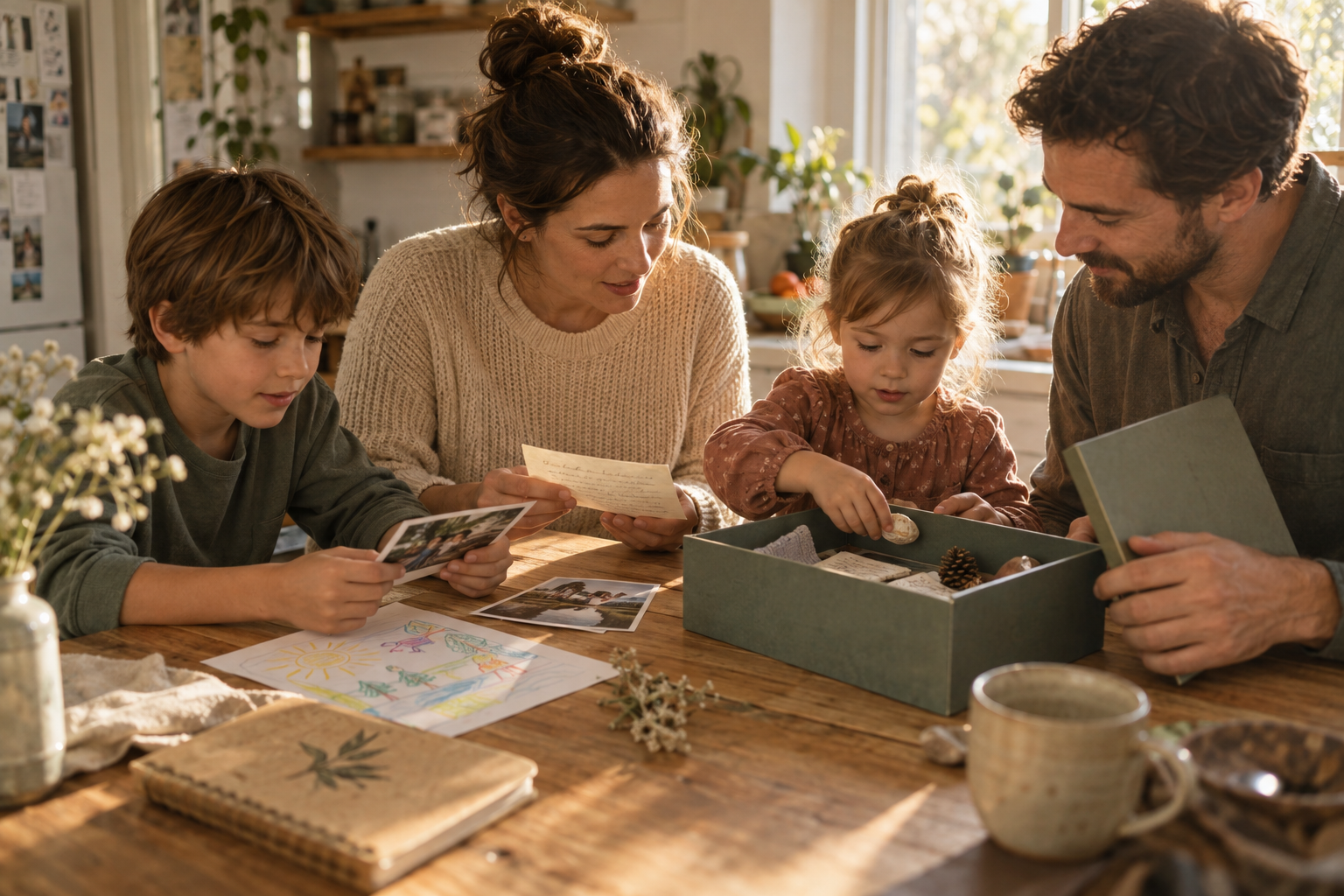
A family time capsule can be more than a box made for a new baby or a message waiting for an eighteenth birthday. It can capture the family you are right now: the jokes at dinner, the view from the school run, the song everyone knows, the small routines that make this particular season yours.
The best part is that everyone can help. A four-year-old can draw the household. A ten-year-old can list today's favorite things. A teenager can choose a photo and add a sentence in their own words. Adults can record the practical details children rarely notice until they are gone.
Then you choose a future occasion to open the collection together. That might be next summer, after a move, on a birthday, or two years from today. Make time to gather, look back, and notice what changed.
If your family includes a baby, What to Save From Your Baby's First Months focuses on early sounds, gestures, and ordinary scenes. If you want a writing-first approach during the first year, Letters to My Baby offers prompts for messages from parent to child. This guide is broader: it is for families with children at different ages who want one shared snapshot.
Start with the opening moment
Before deciding what to put inside, picture the day you will return to it.
Do you want to open it after one school year? On the first night in a new home? At the end of a two-year family chapter? During an annual gathering when everyone is likely to be in the same place?
Choose a moment that is:
- far enough away for change to feel visible
- near enough that the plan feels real
- easy to explain to every child taking part
- connected to your family's actual calendar
A date gives the capsule a boundary. It helps everyone decide what belongs. If you are opening it next summer, save details that might change by then. If you are opening it after a move, capture what home feels like now. If the occasion is a birthday, ask each person to predict what the birthday child will love by then.
Write the date at the top of your first note and add one sentence: “We are opening this together because…” That is enough to turn a collection into a shared promise.
What to save in a family time capsule
The goal is not to represent every part of family life. It is to choose a handful of things that will start conversation later.
A snapshot of an ordinary day
Describe one normal weekday from morning to bedtime. Include the details no one would put in a holiday card:
- who wakes first
- what breakfast looks like
- which bag is always nearly forgotten
- what plays in the car or kitchen
- who chooses the evening story
- what the house sounds like after everyone settles
An ordinary-day note gives future readers a place to stand. It reminds them not just what happened, but how family life moved.
One contribution from every person
Give each family member the same small prompt: “What do you want us to remember about right now?”
Young children can answer in a drawing. School-age children can write three sentences. Teenagers can choose a photograph, a screenshot of a harmless everyday detail, or a short list. Adults can add a note about the household, work, friendships, or the phase each child is in.
Keep each contribution in the person's own words. Do not correct a child's spelling or rewrite a teenager's answer into something more sentimental. Their voice is part of what you are saving.
A family phrase or inside joke
Inside jokes age quickly, which makes them perfect capsule material. Write the phrase down and explain just enough for it to make sense later.
You might include:
- a nickname that only lasted one year
- a phrase a younger child always says incorrectly
- the line everyone repeats from a favorite film
- a joke born during a holiday or difficult week
- the made-up name for a familiar meal
These details often do more emotional work than a formal summary because they sound like the family from the inside.
A photo of the place, not only the people
Portraits matter, but rooms carry memory too. Photograph the kitchen table after breakfast, the shoes by the door, the noticeboard, the garden corner, or the sofa where everyone competes for space.
Add a caption with the date, names, and one thing happening outside the frame. The National Archives' guidance on preserving family papers and photographs is a useful reminder that good handling and clear context help family material survive and remain understandable.
Predictions everyone can revisit
Predictions make the opening lively without requiring anyone to write a profound letter.
Ask:
- What will each person be interested in?
- Which routine will still exist?
- What will be different about the house?
- Which food, song, or game will we still love?
- What do we hope we will have done together?
Let everyone answer independently. The point is not to be right. It is to see what people imagined from where they stood.
One object—or a photograph of it
If you are making a physical box, choose one small object from each person. If the object is fragile, useful, or too large, photograph it instead and add a short note.
A child might choose a ticket, drawing, friendship bracelet, recipe card, or small toy. An adult might choose a café receipt, a handwritten shopping list, a seed packet from the garden, or a copy of the week's calendar.
For careful physical storage, What to Put in a Baby Keepsake Box includes a simple editing and labeling method that works beyond baby keepsakes too.
Make it work for children of different ages
A shared capsule should not require every person to contribute in the same way. Give each child a task that fits what they can do now.
For toddlers and preschoolers
Ask one question aloud and write the answer exactly as they say it. Let them draw the family or choose one photo. Date the page and resist explaining too much; their unexpected answer is the keepsake.
For school-age children
Offer a short menu: a favorite-things list, a drawing of home, a note to their future family, or three predictions. A clear limit makes the activity feel finishable.
For teenagers
Give them privacy and choice. Invite a photograph, a short note, a list, or, in a physical box, a sealed envelope for the future opening. Do not require a public reading when the capsule is opened. Participation should feel respectful, not performative.
For adults and grandparents
Ask for a concrete story instead of a broad life lesson. “What happened at dinner last Sunday?” will usually produce a warmer answer than “What wisdom do you want to pass on?” Grandparents can describe a family resemblance, a current tradition, or something the children do that makes them laugh.
Family rituals can be simple, repeated activities that create connection, as the American Academy of Pediatrics notes in its overview of family rituals. Making and opening a capsule can become one such occasion without turning it into a demanding annual project.
How to build the capsule in one evening
You do not need a weekend craft plan. Set aside 30 to 45 minutes and keep the scope small.
- Name the opening occasion. Write the date and why you chose it.
- Choose one prompt. Use the same question for everyone.
- Collect one contribution each. A note, drawing, or photo is enough.
- Add one household snapshot. Capture the room or routine around you.
- Label everything. Include names, date, and a line of context.
- Put the opening date on the family calendar. Plan to gather in person if that matters to you.
Stop when the collection tells a clear story. A family capsule becomes harder to finish when everyone thinks they must search the whole house or summarize an entire childhood.
Plan the day you will open it
Opening together is an occasion you arrange. The capsule can arrive or become available on a chosen date, but the family still decides where to meet, who will read, and how private contributions will be handled.
Keep the opening simple:
- choose a room where everyone can sit comfortably
- let each person decide whether to read their contribution aloud
- compare predictions without scoring them
- ask what feels most surprising now
- take one new photo of the family on opening day
You may want to start a second capsule after opening the first. That is optional. The original occasion is complete even if you simply spend an hour remembering together.
A small digital version with Echo
For a near-term capsule made of text and images, Preserly's free Echo capsule can be a simple starting point. Echo supports up to two recipients and a delivery date within the next two years. It is useful for a small version of this idea: for example, one parent creates the capsule and sends it to another adult or older child, then the family plans to gather on delivery day.
Collect everyone's words and photos first, then have one adult add them to the capsule. Choose a recipient who can bring the delivered capsule to your family gathering. Everything inside should be suitable for that recipient to see; keep any private letters in separate envelopes or capsules. For other media formats or a longer timeframe, compare the available plans.
Start a free Echo capsule with one family photo, everyone's short answer to the same prompt, and a delivery date within the next two years.
Questions to use when the page is blank
Choose one or two. More questions do not automatically create a better capsule.
- What makes our home feel like ours right now?
- What is the funniest thing someone said this week?
- Which routine would we miss if it changed tomorrow?
- What does each person hope we do together before opening day?
- What are we all watching, reading, cooking, or listening to?
- What is difficult now that may feel different later?
- What do we want to thank one another for?
- What will surprise us most when we read this again?
FAQ
What should go in a family time capsule?
Start with one contribution from each person, one honest photo of the home, one family phrase, a few predictions, and the opening date. Keep the collection small enough that everyone can finish it.
Does a family time capsule have to be for a baby?
No. It can capture any family season, including a school year, a move, a reunion, a new household routine, or a period when children are at very different ages.
How far in the future should we open it?
Choose a date far enough away for change to be noticeable but close enough that the family can picture the occasion. A year or two works well for a near-term text-and-image capsule, but the right date depends on the memory and the format you choose.
Can the whole family open it together?
Yes. Choose a recipient who can share the delivered capsule at your gathering. Plan a day to sit together, revisit the photos, and read the notes people want to share.
What if family members do not want to share their contribution aloud?
Respect that choice. Agree which contributions everyone may see and which people want to read aloud. Keep private messages separate from the shared collection; a note inside a shared digital capsule is visible to its recipients.
Save the family you are today
A family time capsule does not need to tell your complete story. It only needs to carry enough truth for everyone to recognize the season later.
Choose an opening date. Ask one question. Save one contribution from each person and one photograph of ordinary home life. The future moment will come from gathering around those pieces and saying, “Do you remember this?”
If a small text-and-image version with up to two recipients fits your plan, start a free Echo capsule and choose a delivery date within the next two years.